
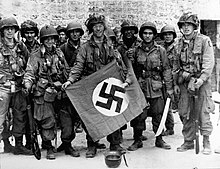
The 101st Airborne Division (Air Assault) ("Screaming Eagles") is a light infantry division of the United States Army that specializes in air assault operations. It can plan, coordinate, and execute multiple battalion-size air assault operations to seize terrain. These operations can be conducted by mobile teams covering large distances, fighting behind enemy lines, and working in austere environments with limited or degraded infrastructure.
The 101st Division headquarters was organized 2 November 1918 at Camp Shelby, Mississippi, having been constituted on 23 July in the National Army. World War I ended nine days later, and the division was demobilized on 11 December 1918.
In 1921, the division headquarters was reconstituted in the Organized Reserves, and organized on 10 September 1921, at Milwaukee, Wisconsin. It was at this time that the "Screaming Eagle" mascot became associated with the division, as a successor to the traditions of the Wisconsin volunteer regiments of the American Civil War.
On 30 July 1942, the Army Ground Forces ordered the activation of two airborne divisions by 15 August 1942. The 82nd Division, an Organized Reserve division ordered into active military service in March 1942, was ordered to provide cadre to the 101st Division, the other division selected for the project, for all elements except parachute infantry. As part of the reorganization of the 101st Division as an airborne division, the unit was disbanded in the Organized Reserve on 15 August 1942 and reconstituted and reactivated in the Army of the United States. On 19 August 1942, its first commander, Major General William C. Lee
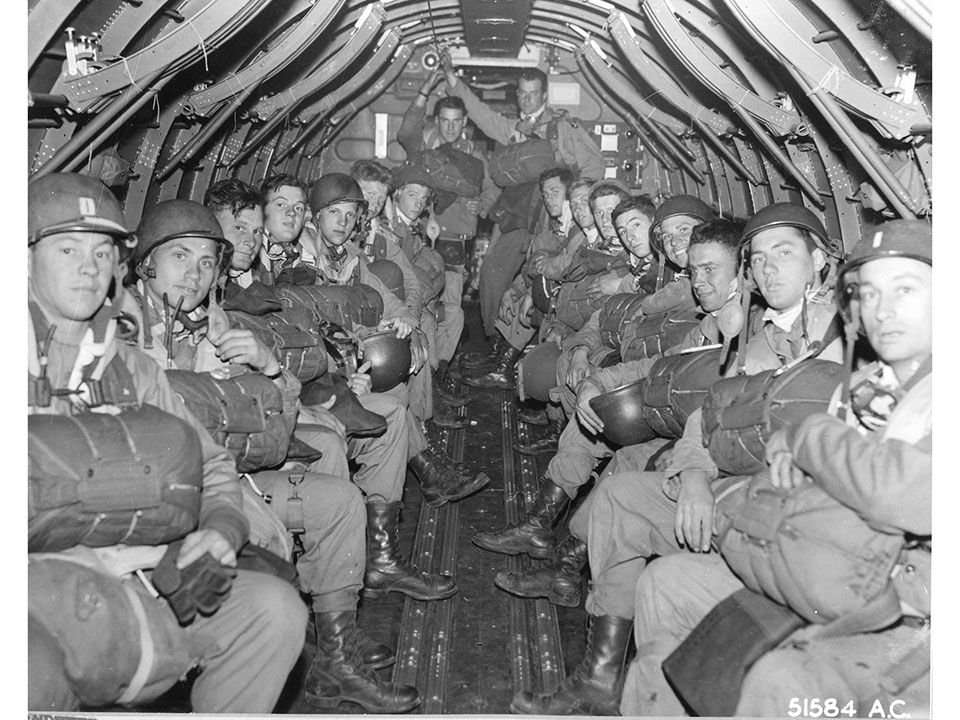
The pathfinders of the 101st Airborne Division led the way on D-Day in the night drop before the invasion. They left from RAF North Witham, having trained there with the 82nd Airborne Division. These night drops caused a lot of trouble for the gliders. Many crashed and equipment and personnel were lost.
The 101st Airborne Division's objectives were to secure the four causeway exits behind Utah Beach between Saint-Martin-de-Varreville and Pouppeville to ensure the exit route for the 4th Infantry Division from the beach later that morning. The other objectives included destroying a German coastal artillery battery at Saint-Martin-de-Varreville, capturing buildings nearby at Mézières believed used as barracks and a command post for the artillery battery, capturing the Douve river lock at La Barquette (opposite Carentan), capturing two footbridges spanning the Douve at La Porte opposite Brévands, destroying the highway bridges over the Douve at Saint-Côme-du-Mont, and securing the Douve River valley. Their secondary mission was to protect the southern flank of VII Corps. They destroyed two bridges along the Carentan highway and a railroad bridge just west of it. They gained control of La Barquette locks, and established a bridgehead over the Douve which was located north-east of Carentan.
In the process, units also disrupted German communications, established roadblocks to hamper the movement of German reinforcements, established a defensive line between the beachhead and Valognes, cleared the area of the drop zones to the unit boundary at Les Forges, and linked up with the 82nd Airborne Division.
The paratroopers of the 101st Airborne Division jumped between 00:48 and 01:40 British Double Summer Time of 6 June. The first wave, inbound to Drop Zone A (the northernmost), was not surprised by the cloud bank and maintained formation, but navigating errors and a lack of Eureka signal caused the first error. Although the 2nd Battalion, 502nd Parachute Infantry Regiment was dropped as a compact unit, it jumped on the wrong drop zone, while its commander, Lt. Col. Steve A. Chappuis, came down virtually alone on the correct drop zone. Chappuis and his stick captured the coastal battery soon after assembling, and found that it had already been dismantled after an air raid.
Most of the remainder of the 502nd (70 of 80 sticks) dropped in a disorganized pattern around the impromptu drop zone set up by the pathfinders near the beach. The battalion commanders of the 1st and 3rd Battalions, Lt. Col. Patrick J. Cassidy and Lt. Col. Robert G. Cole, took charge of small groups and accomplished all of their D-Day missions. Cassidy's group took Saint Martin-de-Varreville by 06:30, sent a patrol under S/Sgt. Harrison C. Summers to seize the "XYZ" objective, a barracks at Mésières, and set up a thin line of defense from Foucarville to Beuzeville. Cole's group moved during the night from near Sainte-Mère-Église to the Varreville battery, then continued on and captured Exit 3 at 07:30. They held the position during the morning until relieved by troops moving inland from Utah Beach. Both commanders found Exit 4 covered by German artillery fire and Cassidy recommended to the 4th Infantry Division that it not use the exit.
The division's parachute artillery did not fare nearly as well. Its drop was one of the worst of the operation, losing all but one howitzer and dropping all but two of 54 loads four to twenty miles (32 km) to the north, where most ultimately became casualties.
The second wave, assigned to drop the 506th Parachute Infantry Regiment (PIR) on Drop Zone C 1 mile (1.6 km) west of Sainte Marie-du-Mont, was badly dispersed by the clouds, then subjected to intense antiaircraft fire for 10 miles (16 km). Three of the 81 C-47s were lost before or during the jump. One, piloted by 1st Lt. Marvin F. Muir of the 439th Troop Carrier Group, caught fire. Muir held the aircraft steady while the stick jumped, then died when the plane crashed immediately afterward, for which he was awarded the Distinguished Service Cross. Despite the opposition, the 506th's 1st Battalion (the original division reserve) was dropped accurately on DZ C, landing two-thirds of its sticks and regimental commander Col. Robert F. Sink on or within a mile of the drop zone.
Most of the 2nd Battalion had jumped too far west, near Sainte-Mère-Église. They eventually assembled near Foucarville at the northern edge of the 101st Airborne's objective area. It fought its way to the hamlet of le Chemin near the Houdienville causeway by mid-afternoon, but found that the 4th Division had already seized the exit hours before. The 3rd Battalion of the 501st PIR, led by Lt. Col. Julian J. Ewell , also assigned to jump onto DZ C, was more scattered, but took over the mission of securing the exits. An ad hoc company-sized team that included division commander Maj. Gen. Maxwell D. Taylor reached the Pouppeville exit at 06:00. After a six-hour house-clearing battle with elements of the German 1058th Grenadier Regiment, the group secured the exit shortly before 4th Division troops arrived to link up.
The third wave also encountered severe flak, losing six aircraft. The troop carriers still made an accurate drop, placing 94 of 132 sticks on or close to the drop zone, but part of the DZ was covered by pre-registered German machine gun and mortar fire that inflicted heavy casualties before many troops could get out of their chutes. Among the killed were two of the three battalion commanders and the executive officer of the 3/506th.
The surviving battalion commander, Lt. Col. Robert A. Ballard, gathered 250 troopers and advanced toward Saint Côme-du-Mont to complete his mission of destroying the highway bridges over the Douve. Less than half a mile from his objective at les Droueries he was stopped by elements of battalion III/1058 Grenadier-Rgt. Another group of 50 men, assembled by the regimental S-3, Major Richard J. Allen, attacked the same area from the east at Basse-Addeville but was also pinned down.
The commander of the 501st PIR, Col. Howard R. Johnson, collected 150 troops and captured the main objective, la Barquette lock, by 04:00. After establishing defensive positions, Col. Johnson went back to the DZ and assembled another 100 men, including Allen's group, to reinforce the bridgehead. Despite naval gunfire support from the cruiser Quincy, Ballard's battalion was unable to take Saint Côme-du-Mont or join Col. Johnson.
The S-3 officer of the 3rd Battalion 506th PIR, Capt. Charles G. Shettle, put together a platoon and achieved another objective by seizing two foot bridges near la Porte at 04:30 and crossed to the east bank. When their ammunition drew low after knocking out several machine gun emplacements, the small force withdrew to the west bank. It doubled in size overnight as stragglers came in and repulsed a German probe across the bridges.
The Ardennes Offensive (16 December 1944 – 25 January 1945) was a major German offensive launched towards the end of World War II through the forested Ardennes Mountains region of Belgium. Germany's planned goal for these operations was to split the British and American Allied line in half, capturing Antwerp, Belgium in the process, and then proceeding to encircle and destroy the entire British 21st Army Group and all 12th U.S. Army Group units north of the German advance, forcing the Western Allies to negotiate a peace treaty in the Axis Powers' favor as a result. In order to reach Antwerp before the Allies could regroup and bring their superior air power to bear, German mechanized forces had to seize all the major highways through eastern Belgium. Because all seven of the main roads in the Ardennes converged on the small town of Bastogne, control of its crossroads was vital to the success or failure of the German attack.
Despite several notable signs in the weeks preceding the attack, the Ardennes Offensive achieved virtually complete surprise. By the end of the second day of battle, it became apparent that the 28th Infantry Division was near collapse. Maj. Gen. Troy H. Middleton, commander of VIII Corps, ordered part of his armored reserve, Combat Command B of the 10th Armored Division to Bastogne.[notes 5] Meanwhile, Gen. Eisenhower ordered forward the SHAEF reserve, composed of the 82nd and 101st Airborne, which were stationed at Reims.
Both divisions were alerted on the evening of 17 December, and not having organic transport, began arranging trucks for movement forward, the weather conditions being unfit for a parachute drop. The 82nd, longer in reserve and thus better re-equipped, moved out first. The 101st left Camp Mourmelon on the afternoon of 18 December, with the order of march the division artillery, division trains, 501st PIR, 506th PIR, 502nd PIR, and 327th Glider Infantry. Much of the convoy was conducted at night in drizzle and sleet, using headlights despite threat of air attack to speed the movement, and at one point the combined column stretched from Bouillon, Belgium, back to Reims.
The 101st Airborne was routed to Bastogne, located 107 miles (172 km) away on a 1,463 feet (446 m) high plateau, while the 82nd Airborne took up positions further north to block the critical advance of Kampfgruppe Peiper toward Werbomont, Belgium. The 705th Tank Destroyer Battalion, in reserve sixty miles to the north, was ordered to Bastogne to provide anti-tank support to the armorless 101st Airborne on the 18th and arrived late the next evening. The first elements of the 501st PIR entered the division assembly area four miles west of Bastogne shortly after midnight of 19 December, and by 09:00 the entire division had arrived.
By 21 December, the German forces had surrounded Bastogne, which was defended by both the 101st Airborne and Combat Command B of the 10th Armored Division. Conditions inside the perimeter were tough—most of the medical supplies and medical personnel had been captured on 19 December. CCB of the 10th Armored Division, severely weakened by losses in delaying the German advance, formed a mobile "fire brigade" of 40 light and medium tanks (including survivors of CCR of the 9th Armored Division, which had been destroyed while delaying the Germans, and eight replacement tanks found unassigned in Bastogne). Three artillery battalions, including the all-black 969th Field Artillery Battalion, were commandeered by the 101st and formed a temporary artillery group. Each had 12 155 mm howitzers, providing the division with heavy firepower in all directions restricted only by its limited ammunition supply (By 22 December artillery ammunition was restricted to 10 rounds per gun per day.) The weather cleared the next day, however, and supplies (primarily ammunition) were dropped over four of the next five days.

Despite several determined German attacks, the perimeter held. The German commander, Generalleutnant Heinrich Freiherr von Lüttwitz, requested Bastogne's surrender. When General Anthony McAuliffe, now acting commander of the 101st, was told, he commented : "Nuts!" After turning to other pressing issues, his staff reminded him that there should be a reply to the German demand. One officer (Harry W. O. Kinnard, then a lieutenant colonel) recommended that McAuliffe's reply should be "tough to beat". Thus, McAuliffe wrote on the paper delivered to the Germans: "NUTS!" That reply had to be explained, both to the Germans and to non-American Allies.
Both of the two panzer divisions of the XLVII Panzer Corps moved forward from Bastogne after 21 December, leaving only one panzergrenadier regiment of the Panzer-Lehr-Division to assist the 26th Volksgrenadier Division in attempting to capture the crossroads. The 26th VG received additional armor and panzergrenadier reinforcements on Christmas Eve to prepare for its final assault, to take place on Christmas Day. Because it lacked sufficient armor and troops and the 26th VG Division was near exhaustion, the XLVII Panzer Corps concentrated the assault on several individual locations on the west side of perimeter in sequence rather than launching one simultaneous attack on all sides. The assault, despite initial success by German tanks in penetrating the American line, was defeated and virtually all of the German tanks involved were destroyed. The next day, 26 December, the spearhead of General George S. Patton's U.S. Third Army relief force, the 4th Armored Division, broke through the German lines and opened a corridor to Bastogne, ending the siege. The division got the nickname "The Battered Bastards of the Bastion of Bastogne".
With the encirclement broken, the men of the 101st expected to be relieved, but were given orders to resume the offensive. The 506th attacked north and recaptured Recogne on 9 January 1945, the Bois des Corbeaux (Corbeaux Wood), to the right of Easy Company, on 10 January, and Foy on 13 January. The 327th attacked towards Bourcy, northeast of Bastogne, on 13 January and encountered stubborn resistance. The 101st Airborne Division faced the elite of the German military which included such units as 1st SS Panzer Division Leibstandarte SS Adolf Hitler, Führerbegleitbrigade, 12th SS Panzer Division Hitlerjugend, and the 9th SS Panzer Division Hohenstaufen. The 506th retook Noville on 15 January and Rachamps the next day. The 502nd reinforced the 327th, and the two regiments captured Bourcy on 17 January, pushing the Germans back to their point of advance on the day the division had arrived in Bastogne. The next day the 101st Airborne Division was relieved.

Major General William Carey Lee was a senior United States Army officer who fought in World War I and World War II, during which he commanded the 101st Airborne Division, nicknamed the "Screaming Eagles". Lee is often referred to as the "Father of the U.S. Airborne".
Lee was born in Dunn, North Carolina, one of the seven children of Eldridge Lee and his wife Emma. His father was a merchant. Lee attended Wake Forest College and North Carolina State College. He participated in the Reserve Officer Training Corps (ROTC) program, graduated from NC State, being commissioned as a second lieutenant in the Infantry Branch of the United States Army in 1917, after the American entry into World War I. Lee served in World War I with the American Expeditionary Forces (AEF), which was commanded by General John J. Pershing, on the Western Front. During the war, he served as a platoon and company commander in the 81st Division.
He stayed in the Army during the interwar period and, soon after the war ended, and taking an interest in armored warfare, he attended the tank warfare training schools in Fort Meade, Maryland, and at Versailles, France. In the 1930s, he attended the U.S. Army Command and General Staff School and was promoted to major soon after. On a tour of Europe, he observed the revolutionary new German airborne forces, a concept that he believed the U.S. Army should adopt. He returned to the United States, where he was ordered to the Office of the Chief of Infantry at Washington, D.C. On August 18, 1940, he was promoted to lieutenant colonel.
By the time the United States entered World War II in December 1941, Lee, promoted to the temporary rank of colonel on December 24, was a proponent of airborne warfare. Lee had observed smokejumper training methods within the past year to lay a template for training. President Franklin D. Roosevelt sponsored the concept, and Lee was authorized to form the first paratroop platoon, which was commanded by William T. Ryder. This was followed by the Provisional Parachute Group, and finally the U.S. Army Airborne Command, which he took command of on March 21, 1942, which was followed shortly afterwards by a temporary promotion to brigadier general on April 19. Lee was the first commander of the U.S. Army's jump school at Fort Benning, Georgia. His Army Distinguished Service Medal was awarded, "for exceptionally meritorious and distinguished services to the Government of the United States, in a duty of great responsibility during World War II."
In August 1942, Lee, promoted on August 9 to the two-star rank of major general, became the first Commanding General (CG) of the newly formed 101st "Screaming Eagles" Airborne Division, based at Camp Claiborne, Louisiana. He told his men:
''The 101st has no history, but it has a rendezvous with destiny.''
He trained the 101st in the United States from its creation until being sent to England in September 1943 to prepare for the Allied invasion of Normandy, codenamed Operation Overlord.
Lee helped plan the American airborne landings in Normandy and trained to jump with his men. On February 5, 1944, a damp, wet and cloudy day, Lee was on his way to observe a training exercise by the 401st Glider Infantry Regiment, commanded by Lieutenant Colonel Joseph "Bud" Harper. Lee suddenly claimed to Harper, "Bud, I can't go any farther, I have a terrible pain in my chest." Harper managed to secure the services of a truck nearby and Lee was evacuated to the 302nd Field Hospital, where doctors diagnosed a serious heart attack. Although the Army wanted to send him back to the United States for better treatment, Lee refused, believing, in vain, that he might return to the 101st, where Lieutenant General Omar Bradley had promised to hold his command.
Lee remained in hospital until March, when he had a second heart attack and was returned to the United States, where he would be retired from the Army for reasons of ill health in late 1944.
Copyright ©Endsieg 2021