
The 100th Jäger Division, formerly the 100th Light Infantry Division (German: 100. Leichte Infanterie Division) was a light infantry division of the German Army during World War II. As such, it was provided with partial horse or motor transport and lighter artillery.
The main purpose of the German Jäger Divisions was to fight in adverse terrain where smaller, coordinated formations were more facilely combat capable than the brute force offered by their standard infantry counterparts. The Jäger divisions were more heavily equipped than the mountain Gebirgsjäger equivalents, but not as well armed as a larger infantry division. In the early stages of the war, it was the interface divisions fighting in rough terrain and foothills as well as urban areas, between the mountains and the plains. The Jägers (means "hunters" in German) relied on a high degree of training, and slightly superior communications, as well as their not inconsiderable artillery support. In the middle stages of the war, as the standard infantry divisions were downsized, the Jäger structure of divisions with two infantry regiments, became the standard table of organization.
Initially established in December 1940 as the 100th Light Infantry Division, the unit was raised in Upper Austria, and based in Ried. The 54th Jäger Regiment was detached from the 18th Infantry. The division comprised two-thirds Austrian and one-third Silesian men.
The 100th Light Infantry Division's first campaign as a fighting force was Operation Barbarossa, the invasion of the Soviet Union, where it served with the 17th Army in the Southern Sector. Its first campaign was in the Battle of Uman, followed by action at Kiev and Odessa.
In October, the 369th Reinforced Croatian Infantry Regiment was attached to the division to bolster its size when attacking the Eastern Front.
The formation was the only German Jäger Division that fought at the Battle of Stalingrad. The 100th Light Infantry Division, along with the 369th Reinforced Croatian Infantry Regiment, was virtually destroyed at Stalingrad.
The 100th Jäger Division was reestablished and fought partisans in the Balkans, Croatia, Albania, and was deployed on coastal protection duties in the Strait of Otranto.
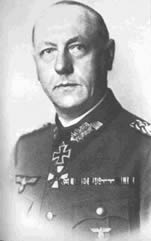
Sanne commanded the 34th Infantry Division from May to November 1940,[1] having earlier been in charge of the 193rd Replacement Division, which served to control replacement units undergoing training. In December 1940, he was appointed commander of the 100th Light Infantry Division, which had just been formed in Vienna. His new command fought entirely on the Eastern Front, firstly in the Ukraine and later in 1942, as part of the 6th Army, at Stalingrad. Promoted to Generalleutnant (lieutenant general) in April 1942, shortly before the division was redesignated as the 100th Jäger Division, he surrendered to the Soviet troops in January 1943 at the conclusion of the Battle of Stalingrad. He died in captivity in 1952.

Willibald Utz was born in Furth im Wald in Bavaria on 20 January 1893. In 1913, at the age of 20, he entered the Bavarian Army as an ensign, and by September 1914 he had been commissioned lieutenant. After serving in World War I he joined the inter-war Reichswehr. By the outbreak of World War II in 1939 he was commander of the 100th (mountain) (Gebirgsjäger) Regiment, and was awarded the Knight's Cross of the Iron Cross for his leadership of this regiment during the invasion of Crete during May and June 1941.
In April 1943, Utz was appointed commander of the newly reconstituted 100th Jäger Division, which had been destroyed at the end of the Battle of Stalingrad. Promoted to major general (generalmajor) on 1 July 1943, he held his command on the Eastern Front from March to December 1944.
Now a lieutenant general (generalleutnant),[3] he took over command of the 2nd Mountain Division on 9 February 1945 when its previous commander was wounded. After fighting on the Western Front in the Saar-Moselle Triangle, his new command, earlier in the war considered an elite unit, was well below strength and combat effectiveness. The division finished the war in Württemberg where Utz surrendered it to the Western Allies.
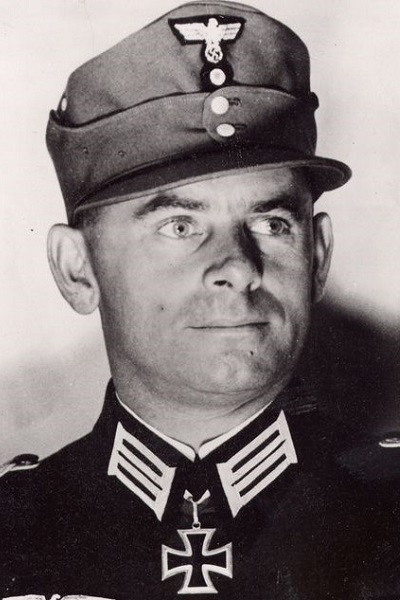
In February 1945, Schury was appointed commander of the 100th Jäger Division. Promoted to major general (Generalmajor) in April, his command surrendered to the Soviet Army in Silesia the following month and Schury was imprisoned in the Soviet Union. He was released in 1955 and died in 1979.

Copyright ©Endsieg 2021